Pages

Saturday, 11 May 2013

Bodgers' Ball 2013

I visited Barn the Spoon at his shop in London on a couple of occasions recently. During our conversations on spoons, tools and broken toilets, he recommended that I go to the Bodgers' Ball. He had me sold on the idea when he said it was like a bigger version of Spoonfest. So I joined the Association of Pole Lathe Turners and Green Woodworkers and managed to snag myself a couple of last minute tickets.
The location of the Bodgers Ball changes each year, and for 2013 the location was Wimpole Hall, near Cambridge. Despite taking about the event with Barn, I didn't really know what to expect. However, driving past a huge pile of logs and into a field of tents and woodchips, I knew I was in the right place. 
The Ball is a three day event (like Spoonfest) and people were camping there. As well as tents, people had set up marques and were demonstrating all manner of traditional crafts. It was absolutely fantastic to see so much skill and wander around a field filled with so many happy, like-minded folk. I even bumped into a few people I met at Spoonfest 2012, which was great. 

Scythe repair/maintenance

I was intrigued by the design of this pole lathe.

Ben Orford gave a brilliant demonstration of how to set up a pole lathe. It was beautiful to see the ease at which he sent wood chips flying.

Really like the look of this armchair by Greenwood Days. They run a 7 day course which will teach you how to make it. 

Never seen a bowl with legs like this before. Definitely something I'd like to try.

Brilliant yew spoon that got my vote for the tool-finish spoon category.


Sean Hellman demonstrating his dragonhead carving. Some very intricate work going on there. 

Nic Westermann braving the downpour to show us how he makes an axehead.


Barn did a brilliant demonstration on how he carves his spoons. I certainly learned a few choice tips from watching him work.


Thursday, 9 May 2013

My 10 Favourite Woodworking Pieces

I love looking at examples of other people's woodworking, almost as much as I enjoy making stuff myself. It's great to look closely at a piece of work, to see the tool marks and through them, the decisions the craftsman made in carving the piece. By looking critically at other's work, trying to understand why they did what they did is a way to making yourself better at your craft.


1 David Fisher Bowl

Really I could put all of David Fisher's bowls here, as well as his awesome shave horse, and be quite happy with that. I love the lines of this bowl, the symmetry and the curves. The tool marks on the inside shows that he was always carving down into the centre of the bowl, whereas I tend to carve longways, from one end to the other. 

2 Barn Spoon

This is the spoon I bought from Barn. It's a fantastically functional spoon. A friend commented that it was a lot more simple than the spoons I create. However the consistency of shape, the sharpness of the lines shows the true talent that went into this spoon. 

3 Robin Wood Porringer

I have two of Robin's porringer bowls that see daily use. They're great to hold plus wonderful to look at. 

4 Sean Hellman Shrink Pot

All of Sean's shrink pots are fantastic, as are the lids he adds to them. The shape of this one really appeals to me, as does the complexity of the decorated lid. 

5 David Fisher Bowl

Another of David's great bowls. The sheer size of this walnut bowl is what strikes me first about this piece. Like all of his work, the lines are so neat, the shape so perfect, it's a great thing to strive for. 

6 Robin Wood Quaich

If it wasn't for these wonderful creations being a little out of my price range I think I would have all my drinks out of these. The collaboration with the silversmith to add the rim makes these Scottish drinking vessels look more like jewellery than a cup.  

7 Steve Tomlin Chair

It just looks so comfortable. Again, it's simple design that draws me to this. As with Barn's spoon, simple designs can hide the skill of the craftsman. This wonderful chair could look like some sticks, planks and a bit of reed to a layman, but the balance of shape, space and form come together brilliantly in an item that is brilliantly functional and no-doubt built to last. 

8 Janharm ter Brugg Spoon

I rarely try to decorate my spoons with kolrossing, but when it is done well it brings an otherwise plain spoon to a new level of beauty. Janharm will be back at Spoonfest this year teaching his engraving techniques and I hope to be able to get on one of his courses. In the meantime I'll keep practising on scrap wood so as not to ruin an otherwise good spoon,

9 Fritiof Spoon

Fritiof's spoons are easily recognised by the parallel lines running along the bowl. I've tried this technique for myself, but don't feel as though it suits my spoons. On his spoons however, the lines work perfectly, almost creating the impression of movement along the bowl. 

10 Simon Hill Spoon


This is the spoon I received from Simon Hill as part of the International Secret Spoon Swap. 120 people signed up to have their names drawn from a hat to send and receive a spoon from other members of the Spoon Carving, Green Woodworking and Sloyd group on Facebook. The delicate chip carving on the handle and the way the lines meet on the neck make this a brilliant spoon.

What pieces of work do you draw inspiration from? Let me know in the comments section.


Tuesday, 7 May 2013

My 3 Favourite Carving Woods

Silver birch (Betula pendula)

Identification


It is easily identified by its white, peeling bark. On the bark, starting at the base, grow dark, rough arrows/diamonds, which can cause the whole base of the tree to appear dark and rough. Birches can grow 30m (100') tall. The shoots on the branches are slender and tend to droop. The leaves are small and trianglar, with ragged teeth along the edges.

Some Traditional Uses

The bark has been used to make containers and even canoes. The thin, flexible branches are used to make besoms (think 'witches broomstick'). Birch poles were also used to stir molten copper as they prevented oxides from forming, which meant a purer copper.

My Birch Carvings


Maples (Acer campestre - field maple, Acer pseudoplatanus - sycamore)

Identification


Tend to be densely crowned, with pale, cracked bark. The leaves are opposite paired with five veins radiating from the stem to five lobes. Most easily recognised by their winged seeds that spiral to the ground like little helicopters. 

Some Traditional Uses

Perhaps most famously used to make violins, with the rippled grain being referred to as 'fiddleback'. The sap can also be boiled down to make syrup.

My Maple Carvings


Hornbeam (Carpinus Betulus)

Identification


The grey, smooth bark makes the trunks look a little like elephant's legs. The leaves a deeply veined with fine, uneven serrations.

Some Traditional Uses


Hornbeam is a very hard wood. As such it has been used for mallet heads, skittles and butchers' chopping blocks. The wood also burns very long and hot, used to smelt iron.

My Hornbeam Carvings

Hornbeam shrink pot

Hornbeam spoon and small shrink pot

What are your favourite woods for carving? Feel free to share examples of your work in the comments section.

Saturday, 4 May 2013

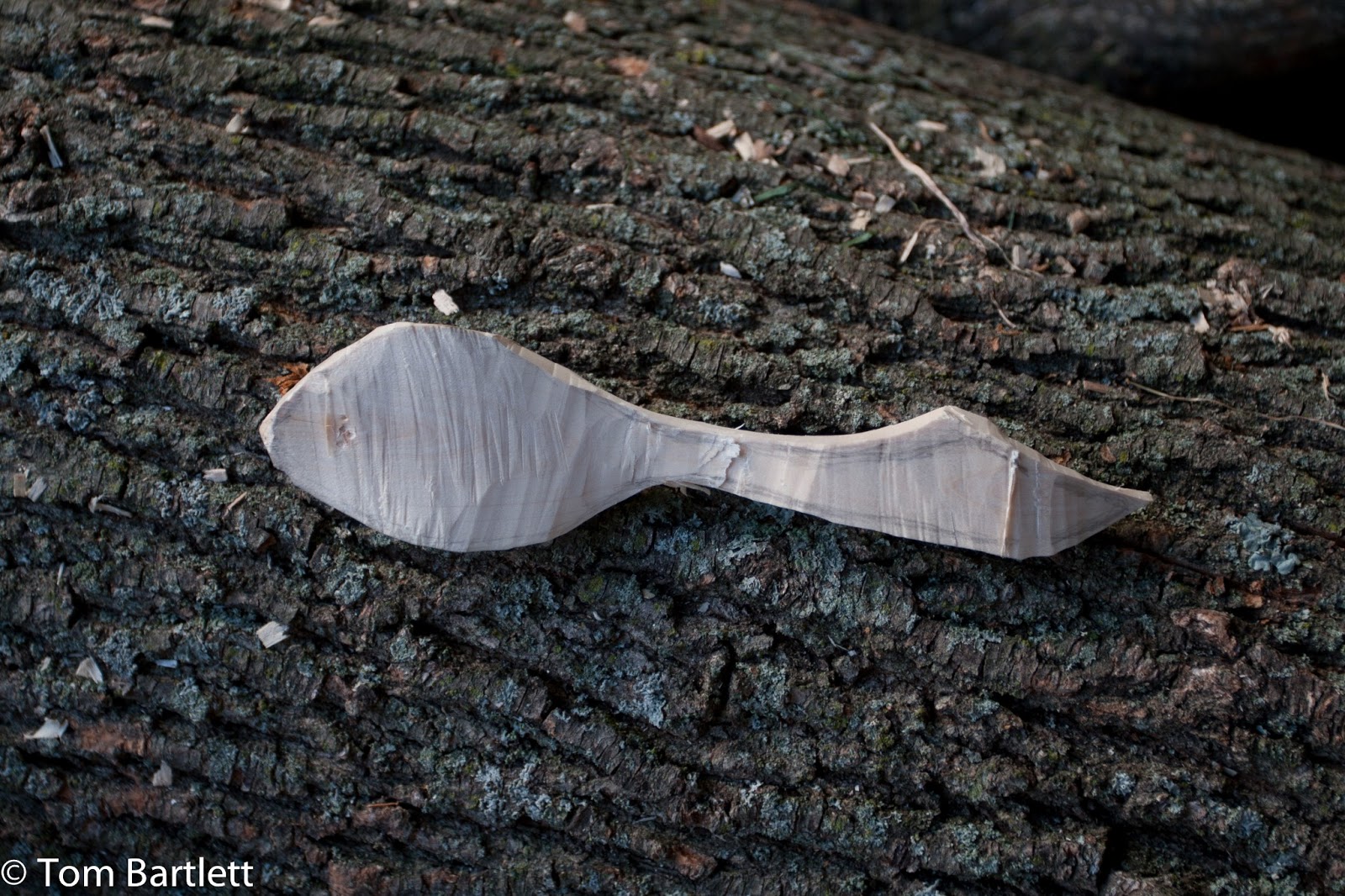
Carved birch spoon

Here's an eating spoon I've carved from a billet of silver birch:


Tuesday, 30 April 2013

Tool-roll: Svante Djarv Small Viking Axe

Yesterday I received my Svante Djarv Small Viking Axe from the Woodsmith Store. I haven't had a chance to try it out yet, but wanted to give my first impressions of it.


Here's the description from the Woodsmith Store:
The Svante Djarv Little Viking Axe is a very useable everyday axe for green wood working made by respected Swedish tool maker Svante Djarv.
These axes are made in very small quantities.
The bit has two equal bevels ground to 30 degrees with distinct shoulders, a long curved bit which extends above the heads eye and the position of the cutting edge in relation to the handle make this a very efficient axe producing a very natural slicing action.
The medium weight head at 800gms has a cutting edge of 140mm, (5 1/2").
The curved ribbed handle in Swedish elm is 340mm (13 1/2") long and very comfortable in the hand with a good grip. As was traditional only a well seasoned wooden wedge is used to fix the head to the handle.
Up until now I've been using the Gransfors Bruks Wildlife hatchet and wanted to get something that a) had a bit more weight behind it to help make bowl carving a little easier and b) was more specifically designed for carving - notably an axe with an upswept bit. With regards to a) the 800g head on the SD Little Viking axe does not feel heavier that the 600g Wildlife hatchet. This might be because the American hickory handle on the Wildlife hatchet is heavier than the Swedish elm of the Little Viking. I'm not 100% sure that this is the case, but the balance of the two axes makes me think that's the case.

SD Little Viking Axe and GB Wildlife Hatchet
I was also surprised by how thin the axe bit is. Hopefully this will mean it will do well slicing. I'm also very happy with the flat grind, which should make it easier to sharpen than the convex grind on the Wildlife hatchet.

I've got a rather large piece of hornbeam sitting in my woodpile that has been waiting for this axe to arrive. I'll dig it out and report back on how the Little Viking axe holds up against 'ironwood' hornbeam.

Big lump of hornbeam at the bottom


Tool-roll


 Tool-roll


Most of the carving I do could easily be done with three tools: an axe, a knife and a curved 'spoon knife' or gouge. However I have about ten different tools in fairly regular use:


From left to right they are as follows: HK bent gouge (40-90), Laplander folding saw, Mora 120, Mora 106, HK right handed spoon knife, custom Ben Orford sloyd knife and Nic Westermann chip carver. 


These are my more heavy duty wood removal tools. A HK 50mm adze, Svante Djarv Little Viking axe and Gransfors Bruks Wildlife hatchet. Below it is my Ben Orford Woodlander with the SD Little Viking Axe.  I'll be writing some detailed reviews of each of these tools over the coming weeks.

Monday, 29 April 2013

Review: Gransfors Bruks Wildlife Hatchet

It is fair to say that Gransfors Bruks make the best widely available axes out there. One of their most popular models is the Wildlife Hatchet. Here's the description from their site:


A small, light axe wich can be easily carried, masked with its leather sheath, inside your pack or on your belt. Even with a small axe you can manage a lot: cut branches in the back-yard or chop and split sticks for a camp fire. This little hatchet awakes in many of us memories and dreams of exciting camps and adventures.
The hatchet has a 3" face and a 13 1/2 " hickory handle and the head weighs 1 lb.
It comes with a grain-leather sheath.
I've had my GB hatchet for about four years now. It has the initials of the fellow that made it stamped into it - MM - which belong to Mattias Mattsson. This personalisation is a reflection of the philosophy of an "unlimited responsibility of the Total" taken at Gransfors Bruks. It's nice to know that there are successful companies out there which view themselves as responsible for the lifetime of their products. I've been fortunate enough to visit the Gransfors Bruks factory and the pristine countryside it sits in is a testament to the care they take to preserve the environment, whilst creating quality products.

Near the Gransfors factory
It's been in my backpack to over five countries. I've used it to fell small trees, limb fallen trees, split small rounds of fire wood, hammer in tent pegs and even to open walnuts. However it is most often used for carving.

Sugar maple with more work to do


For spoon carving it is a great axe. The small, relatively light head means it's easy to use for extended periods of time. I've found that it holds its edge very well and the hickory handle is very comfortable. Most of the time I'm using the axe 'choked up' - with my hand very close, or partly holding, the head. This allows for very fine carving, useful for quickly getting spoon blanks into a shape that doesn't require so much knife work.

Recently I've been trying my hand at bowl carving. At this endeavour there is a slight drawback to the lightness of the axe - wasting large amounts of wood can be tiresome. A heavier axe with a longer edge would be useful.

If you are looking for a good all-rounder then this axe is fantastic. However there are several axes out there that are more specifically designed for sculptural carving, but I have yet to try these. Once I do, I'll be sure to let you know my thoughts on the matter.

If you've used the GB Wildlife hatchet it would be great to hear your thoughts on it in the comments section below.